
Introduction
Have you ever wondered why some posts suddenly appear everywhere? One moment you’re scrolling casually, and the next, the same post is being shared, reposted, and talked about by thousands of people.
It’s easy to assume that viral content is just luck. But in reality, there is a deeper reason behind why people share content online. It’s not random—it’s psychological.
Every share, like, and comment is driven by human emotions, behaviors, and social instincts. Understanding this psychology is what separates average content from content that spreads rapidly.
In this blog, we’ll break down the key psychological triggers behind viral content and understand why people feel compelled to hit the “share” button.
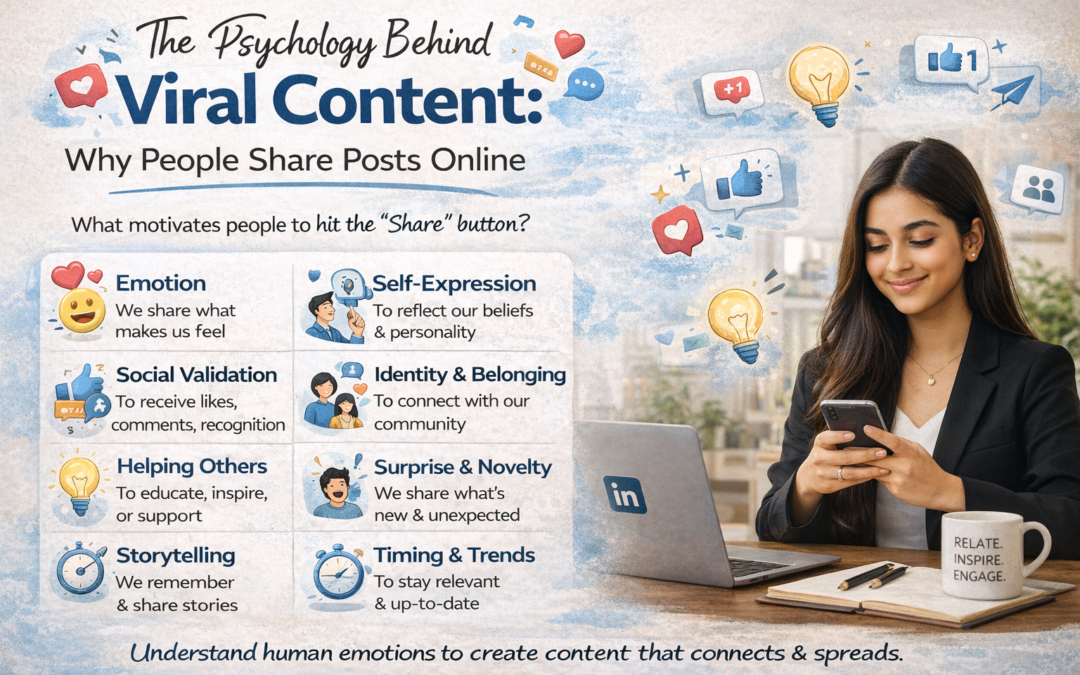
1. People Share Content That Makes Them Feel Something
At the core of every viral post is emotion.
People don’t share content because it’s “informative”—they share it because it makes them feel something. That feeling could be:
- Happiness
- Inspiration
- Surprise
- Anger
- Relatability
Emotional content creates a stronger connection. It stays in the mind longer and pushes people to take action.
For example, a motivational story about someone overcoming challenges is more likely to be shared than a simple informational post. Why? Because it creates an emotional impact.
The stronger the emotion, the higher the chances of sharing.
2. Sharing is a Form of Self-Expression
When people share content, they are not just sharing information—they are expressing themselves.
Every share reflects something about the person:
- Their beliefs
- Their personality
- Their interests
- Their values
For instance:
- Sharing a career-related post shows ambition
- Sharing a funny post shows a sense of humor
- Sharing an insightful post shows knowledge
This is why people are selective about what they share. They want their online presence to represent who they are.
As a content creator, if your content helps people express themselves, it becomes more shareable.
3. Social Validation Plays a Big Role
Humans naturally seek validation.
When someone shares a post, they are also looking for:
- Likes
- Comments
- Recognition
This creates a cycle:
- People share content
- They receive engagement
- This reinforces the behavior
Content that is already gaining traction is more likely to be shared because people feel it is “safe” and socially accepted.
This is often referred to as the bandwagon effect—people follow what others are already engaging with.
4. Relatability Increases Shareability
One of the most powerful drivers of viral content is relatability.
When people see content and think:
“This is exactly me” or “I’ve experienced this,”
they are more likely to share it.
Relatable content works because it:
- Feels personal
- Builds connection
- Creates a sense of belonging
For students and professionals, posts about career struggles, productivity issues, or daily challenges often go viral because many people relate to them.
5. People Share to Help Others
Not all sharing is self-driven—sometimes it’s about helping others.
People often share content that they believe will:
- Educate someone
- Solve a problem
- Add value
For example:
- Study tips
- Career advice
- Marketing insights
This type of content spreads because it is useful.
When your content answers a question or solves a problem, people feel motivated to pass it on.
6. Simplicity Makes Content More Shareable
Complex content rarely goes viral.
People prefer content that is:
- Easy to understand
- Quick to consume
- Clear in message
In today’s fast-paced digital environment, attention spans are short. If someone has to think too much to understand your content, they are less likely to engage with it.
Simple, clear, and structured content performs better because it is accessible to a wider audience.
7. Surprise and Novelty Capture Attention
People are naturally drawn to things that are new or unexpected.
Content that:
- Breaks common beliefs
- Presents surprising facts
- Offers a unique perspective
is more likely to grab attention and be shared.
For example, a post that challenges a popular opinion or presents a fresh insight often sparks curiosity and conversation.
This element of surprise makes people want to share it with others.
8. Storytelling Creates Stronger Connections
Stories are one of the oldest forms of communication—and they are still the most powerful.
A well-told story:
- Engages emotions
- Keeps people interested
- Makes content memorable
Instead of just sharing facts, storytelling adds context and meaning.
For example, sharing a personal journey or a real-life experience makes content more relatable and impactful.
People remember stories—and they share them too.
9. Identity and Belonging Drive Sharing Behavior
Humans have a strong desire to belong.
People share content that aligns with:
- Their community
- Their profession
- Their interests
For example:
- Marketing students share marketing-related posts
- Fitness enthusiasts share health-related content
Sharing becomes a way to connect with like-minded people.
When your content speaks directly to a specific audience, it creates a sense of identity and belonging, increasing its chances of being shared.
10. Timing and Context Matter
Even great content needs the right timing.
A post related to:
- Current trends
- Ongoing discussions
- Relevant events
is more likely to gain traction.
Content that feels timely and relevant naturally gets more attention and shares.
Understanding when your audience is most active and what they are currently interested in can make a big difference.
Common Mistakes That Reduce Shareability
While focusing on what works, it’s also important to understand what doesn’t.
Some common mistakes include:
- Overly promotional content
- Lack of clarity
- Ignoring audience needs
- Trying too hard to go viral
- Inconsistent messaging
Viral content is not about forcing attention—it’s about creating value that people naturally want to share.
Key Takeaways
If we simplify everything, viral content is built on a few core principles:
- Emotion drives action
- People share to express themselves
- Relatability builds connection
- Simplicity improves reach
- Value encourages sharing
Understanding these principles helps you create content that not only gets attention but also gets shared.
Conclusion
Viral content is not magic—it’s psychology in action.
Behind every share is a human reason, whether it’s emotion, identity, value, or connection.
As a marketing student or content creator, the goal should not be to chase virality blindly. Instead, focus on understanding your audience and creating content that resonates with them.
Because when content connects on a human level, sharing becomes natural.
And that’s what truly makes content go viral.